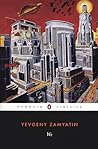
 We by Yevgeny Zamyatin
My rating: 4 of 5 stars
While George Orwell's 1984 and Aldous Huxley's Brave New World are widely known and universally appreciated dystopian novels, not many people have read We by Russian writer Yevgeny Zamyatin. I had also been ignorant of this important work until a student of mine loaned it to me.
We was written in 1920-1921, so I am stunned by how contemporary this 105-year-old novel seems. One of the reasons for that must be the excellent English translation, but the groundbreaking ideas conveyed in the novel give credit to the author alone. The book is set in the 26th century in a totalitarian country called OneState, whose absolute ruler is The Benefactor.
Clarence Brown, the translator, writes in the Introduction that in OneState, "men have finally become, if not actually machines, as machine-like as possible, utterly predictable and completely happy. " Everything is carefully planned and scheduled for all citizens of OneState, including Sex Days. People's names are replaced by numbers, and the narrator, D-503, says, "[...] everybody and I add up to the one We." For citizens who do not follow machine-like routines, operations of imagination removal are available as well as executions, naturally.
One of the central tenets of OneState's ideology is that freedom and happiness are incompatible. The author also presents a parallel dichotomy, which partly explains the incompatibility: "[...] there are two forces in the world, entropy and energy. One of them leads to blissful tranquility, to happy equilibrium. The other leads to the disruption of equilibrium, to the torment of perpetual movement."
The plot describes such a disruption of equilibrium. D-503, is a mathematician and one of the main architects of the space vehicle INTEGRAL, whose construction is about to be finished. D-503 falls in love with I-330, who is a rarity—a rebel citizen. She seduces D-503 to get him to join their cause. I am not going to spoil the further trajectory of the story.
I love the frequent references to mathematics and science, and although in my view the plot is not fully convincing, I wholeheartedly recommend this trailblazing novel. It must have had some influence on Orwell. In fact, he published a review of the novel in 1946, where he effusively praised Zamyatin's work, two or three years before he completed 1984. It might have influenced Huxley as well.
View all my reviews
