Friday, October 30, 2015

What's the Matter with Kansas? How Conservatives Won the Heart of AmericaWhat's the Matter with Kansas? How Conservatives Won the Heart of America by Thomas Frank
My rating: 5 of 5 stars

"Kansans just don't care about economic issues [...] Kansans have set their sights on grander things, like the purity of the nation. Good wages, fair play in farm country, the fate of the small town, even the one that we live in - all these are a distant second to evolution, which we will strike from the books, and public education, which we will undermine in a hundred inventive ways."

The main thrust of Thomas Frank's What's the matter with Kansas: How Conservatives Won the Heart of America, published in 2004, has not lost its relevance in 2015, particularly with the elections coming in the U.S. the next year. The author is trying to elucidate the phenomenon that seems beyond rational explanation: why have a large majority of people living in Kansas - the typical working class population who had solidly voted Democratic before 1980s - switched to supporting conservative Republicans? Why have they begun voting against their own economic interests? Why are there more supporters of conservative agenda among working class people than among those who profit from that agenda? Cutting taxes, reducing government, weakening regulations and customer protection - all these goals favor the rich and hurt the poor and the middle class by reducing or eliminating altogether the social safety net that covers the people who cannot afford to cover themselves. A conservative platform is always pro-business: business owners should be free to reduce salaries, cut and outsource jobs, reduce maternity benefits, avoid paying for medical care of their employees, etc. Why then do the poor people and the exploited people in Kansas vote en masse for the agenda that favors the rich and helps the economic exploiters?

Mr. Frank's answer is clear and convincing. The conservative Republican movement - unable to gain support of the working class on the economic issues - appropriated the religious and social agenda and captured the cultural anger of the working, "ordinary" people, the anger aimed at promotion of "disgusting counterculture", liberal judges, attempts to expand gun control, availability of abortion, liberal media, atheist scientists, immoral decadence, and the secular-humanist disease in general. Much of this anger comes as a backlash against the excesses of the "liberal Sixties", and anti-intellectualism is one of the main unifying themes of the conservative movement.

The leaders of the movement have managed to frame the political choices as the struggle between - on the one side - authentic, hard-working Americans, who enjoy hamburgers, cherish guns, and fervently pray to God, and - on the other - depraved, latte-guzzling, Volvo-driving, liberal, Eastern elite whose ideas are alien to the original values of the true Americans. The conservative leaders have understood that people's cultural, moral, and religious convictions drive their political choices.

The unspoken underlying motto of the conservative movement is to "socialize the risk and privatize the profits". The beauty of the monumental swindle performed by the right-wing ideologists is that the working class people - who will carry the burden of the business risks and will not participate in any of the profits - happily vote to ensure their own poverty and irrelevance, getting instead the feeling of superiority of their religious, moral, and cultural convictions.

In my view (here I need to disclaim that this paragraph is not about Mr. Frank's book) during 11 years since the book was published the situation has gotten worse: one reason is the further polarization of society caused by the universal access to Internet, which allows people to read only the news and articles with which they agree. Another reason for growing support of the conservative agenda are the obvious excesses of the liberal-backed political correctness movement, particularly in the area of diversity enforcement. Yet another new factor is the poor people's fierce resistance to the Affordable Care Act, the law that helps them get access to quality health care: in the authentic American way they prefer to not have any health care rather than to follow some socialist-flavored Canadian or European models.

What's the Matter with Kansas is a meticulously researched work (over 40 pages of notes and references) of unparalleled clarity and thoroughness. I have two critical comments: the author is passionately liberal, and his strong bias shows through his writing. His logically sound and factually correct argument and conclusions would be more effective if they were presented in a cold, unemotional style. My other gripe is that everything in the book is binary, black or white: people are either conservative or liberal. True, the polarization is increasing but there are still substantial numbers of people who agree with some tenets of each side - conservative and liberal - but disagree with some others. There are still some centrists out there.

One of the most thought-provoking books I have ever read.

Four and a half stars.


View all my reviews

Wednesday, October 28, 2015

Capital CrimesCapital Crimes by Lawrence Sanders
My rating: 1 of 5 stars

"Kristos snarls like a cornered beast, lurching about and clawing. He uses his hard strength like a bludgeon. He savages them. He pierces, rends, splits, and tears, full lips drawn back from animal teeth, claws unsheathed."

There are numerous fragments of "prose" as unbelievably bad as the above fragment that describes a sex scene in Capital Crimes (1989). I refuse to believe that Lawrence Sanders himself wrote this abomination of a book. It must have been written by a ghostwriter, and I am just curious why Mr. Sanders, a competent author of many solid crime novels, was so short of cash that he allowed to have his name soiled. Even I can write better than the anonymous hack responsible for this insult to the word "novel".

Not only is the author unable to write prose that can be read without giggling, but also the plot is ridiculous and full of clichés. Brother Kristos has "piercing eyes" and his gaze is so intense and powerful that almost all people are instantaneously hypnotized into following his preaching. He claims he is a "brother of Christ, an apostle sent by God to bring you salvation". When he is not sipping vodka straight from the bottle, eating herring fillets, and having sex with his female acolytes and followers, he is a seer, and has the powers of healing people and farm animals. When the hemophiliac son of the president of the United States hurts himself the good brother stops the bleeding and thus becomes the spiritual advisor to the president. He gradually increases his influence on politics and no wonder: the vice-president is a cretin, and high level government officials discuss politics on the level of kindergarten.

Of course the inspiration for the plot was the story of Grigori Rasputin who achieved similar position in the court of Nicholas II, the last tsar of Russia. How can one botch such an enthralling story so badly? Capital Crimes is a Really Bad Book, whose every chapter, every page, and every passage richly deserve a big fat zero.

One star (so minuscule that one can see it only with an electron microscope).


View all my reviews

Saturday, October 24, 2015

ValparaisoValparaiso by Nicolas Freeling
My rating: 3 of 5 stars

"[...] he was on his way. A way that would eventually lead him across the South Atlantic, around the dreadful cape, up the icy iron coast of Chile, to the sweet mimosa climate, and the beautiful hills and bay of Valparaiso."

Valparaiso (1964) is Nicolas Freeling's fifth novel, and the thirty-third work of his that I am reviewing here. It is Mr. Freeling's first non-series book and the readers hooked on Van der Valk's character must have been disappointed when the novel was published. While I love one-off books as they demonstrate that the writer is trying to be a real author rather than a Machine That Churns Out Series, this novel is not an extraordinary achievement. It is a good, solid, psychological suspense story, yet somewhat modest in the scope of the author's plans.

Raymond Kapitan lives on his yacht Olivia anchored on the island of Porquerolles on the southern coast of France, surviving on a meager inheritance left by his uncle. His life's dream is to sail to Valparaiso in Chile and enjoy its "beautiful hills and bay". Two fateful moments have defined Raymond's life: one when - in his youth - he was humiliated by his then lover's rich and powerful father, and the other - twenty years later - the conversation with Natalie, a vacationing actress with whom he is having an affair, provides the ultimate turning point.

Of course, being Mr. Freeling's work, Valparaiso is extremely well written, yet it is not as virtuosic and erudite as several later novels. The characterizations of all main characters are superbly drawn, and the portrayal of yachting life on the Mediterranean Sea is totally convincing compared to other similarly-themed books I have read. The novel also offers some references and similarities to Joseph Conrad's (Freeling's favorite author) Lord Jim, but it focuses mainly on human impotence against the vagaries of fate.

I am again reminded that there must be something quite wrong with the way I rate books. Valparaiso is just a good book and nowhere near a masterpiece, yet I find it so much better than my previous read, a work considered by many a tour de force - with the average rating of 4.09 (!) on Goodreads - Pop. 1280 . I was briefly considering giving Mr. Thompson's book - despite its lack of narrative consistency and its sole intent to shock the reader with the vileness of the main character - a two-star rating. Had I done that, Mr. Freeling's novel should have been awarded with well over four stars, which it clearly does not deserve. I focus too much on author's writing skills - that's what is wrong with me.

Three and a half stars.


View all my reviews

Wednesday, October 21, 2015

Pop. 1280Pop. 1280 by Jim Thompson
My rating: 1 of 5 stars

"I figure sometimes that maybe that's why we don't make as much progress as other parts of the nation. People lose so much time from their jobs in lynching other people, and they spend so much money on rope and kerosene and getting likkered-up in advance and other essentials, that there ain't an awful lot of money or man-hours left for practical purposes."

Since I did not rate Jim Thompson's Getaway highly, I have been curious about another well-known work by the author, purportedly the master of early hardboiled crime fiction. Alas I like his Pop. 1280 (1964) even less. Much less, in fact.

Nick Corey is the sheriff of Potts County (somewhere in the south of the U.S.), which has a population of 1280. The title of the novel is accurate only at its beginning: the population size is a bit smaller at the end because "somethin' done went and happened to" several people in the meantime. While Nick has only four things on his mind - retaining his job as the election nears, having sex, sleeping, and eating - he has difficulty to focus on his priorities: people do not conform to his wishes, some even need killing.

The author is trying to shock us by showing that people kill other people for simple convenience and then they go to church to praise the Lord loudly and beautifully. Well, I had been shocked before and it is not news to me that the human race would place high in the Worst Scum of the Universe contest.

The author confuses the narrator's voice with his own. While the plot is narrated by Sheriff Corey, it is often the author speaking, as in the wickedly funny fragment quoted in the epigraph. The overall hilarity of this work about utter stupidity and vileness of people does not raise it, in my view, to the two-star level. Well, I should listen to the author's advice and stop wasting time vilifying him. Back to work.

Only the nauseatingly cruel and brutal scene of preparing to execute Uncle John will stay with me.

One and a half stars.


View all my reviews

Sunday, October 18, 2015

Così Fan Tutti (Aurelio Zen, #5)Così Fan Tutti by Michael Dibdin
My rating: 3 of 5 stars

"Everybody in Naples is more or less a gangster, my dear. It's a question of degree."

Zen again. Così fan tutti (1996) is my fifth novel by Michael Dibdin featuring the unconventional, unpredictable, and often unlucky police inspector Aurelio Zen. This time the plot takes us to Naples (the Italian name Napoli - coming from Greek Neapolis - sounds much better, of course), and is closely based on motifs from Lorenzo da Ponte's libretto to Mozart's famous opera buffa Così fan tutte. Note the one-letter difference in spelling of the titles - tutte is feminine while tutti masculine - the substitution is not insignificant for the novel!

Zen is posted to a lowly job of a harbor detail commander in Naples. He tries very hard not to do much in his new job and avoids any involvement in police work, which suits his subordinates fine since they are busy running various lucrative businesses, including a brothel, from the police station. Meanwhile, crime keeps happening in the city: local businessmen disappear, literally treated as garbage by sanitation crews. Zen is supposed to work on the case of Greek sailors knifed in the port by an American counterpart, but he does not exhibit much diligence, instead helping a middle-aged widow arrange an intrigue that aims at breaking her two daughters' infatuation with local hoodlums (this thread of the plot borrows heavily from the opera's libretto).

The romantic intrigue is purely farcical, and the crime-related components of the plot are not the main focus of the story. The author is at his best providing a biting, satirical look at Naples' local character, proving again his superb observation skills and smooth writing. This layer of the novel is also truly hilarious - just imagine the situation when the police force, mourning their comrade fallen in action, are so extreme in their grief that even the whorehouse operating on the police station premises needs to be temporarily closed.

The operatic ending of the novel offers a truly clever denouement. Readers who - unlike myself - like plot twists will love the avalanche of surprises. Revelation are stacked upon revelations, and most of them actually do make sense.

While a lightweight and broad farce, Così fan tutti is a well written, funny, and readable book.

Three stars.


View all my reviews

Thursday, October 15, 2015

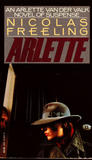
ArletteArlette by Nicolas Freeling
My rating: 4 of 5 stars

"... this was all exceedingly odtaa."

One would think that the acronym craze, the use of LOLs, ROTFLs, AFAIKs, BTWs, etc., began with the birth of the Internet. Apparently not, as evidenced by the "odtaa" acronym used numerous times in Nicolas Freeling's "Arlette" (1981). This is the U.S. title for the novel, I presume, as in the U.K. it was titled "One Damn Thing After Another". The use of the d-word would conceivably hurt sensitive American readers.

The novel describes further adventures of Arlette Davidson, the widow of Commissaire Van der Valk, who runs a one-person "counsellor in personal problems" bureau, thus continuing the story that began in The Widow . One of Arlette's clients is a snobbish woman, a Consul's wife, whose son - after his release from prison where he had served time for selling heroin - escaped to Buenos Aires. Other clients include a police sergeant, who is about to quit the police job not being able to handle the stress and the lack of compassion so common for the force, and a cleaning woman, whose son - while committing a burglary - has been shot dead by the property owner. The woman was badly mistreated by the police while trying to get an apology from the man.

While I find the plot interesting and paced well, I am in total awe of Mr. Freeling's superbly accomplished yet very, very readable writing. His erudite prose is accessible, sophisticated, clever, and quirky, all at once. This is the assured prose by a master of narration, enriched by historical, social, psychological reflections and observations, prose that flows effortlessly, page after page. I wish I could read such prose forever, especially when I feel down, saddled with every day worries.

In addition to the subtle joke involving the acronym (Mr. Freeling refers to a book, whose title explains the acronym, yet his own book has the same title), three other passages deserve high accolades: Arlette's and Arthur's melancholy-filled trip to the house bought by Van der Valk for his retirement (by the way, this is probably the same house that Mr. Freeling lived with his family in the later years of his life), the supremely funny Evelyn Waugh's quote "feather-footed through the plashy fen passes the questing vole", and of course the dreamlike, almost hallucinatory ending of the novel, where Arlette experiences nightmarish adventures, which involve being subject to inexplicably brutal treatment by high-level functionaries of a foreign government. On the other hand, the whole silly episode where amateurs stage a burglary is way below the level of the novel, and made me wince.

Still, a very good, enthralling yet intellectual and literary read.

Three and three quarter stars.


View all my reviews

Monday, October 12, 2015

BrokenBroken by Karin Fossum
My rating: 3 of 5 stars

"This severed bridge, so majestic. But a beautiful construction nonetheless, he could see that: simple but ingenious, beautiful and arched, delicate yet strong. But also amputated [...] It certainly was broken."

Karin Fossum is one of my favorite authors: her writing transcends the genre as she has been able to convey some truths about the human condition under the guise of crime/mystery writing. This is my 12th novel by Ms. Fossum but only the seventh that I have reviewed here (I rated two of her novels, Black Seconds and The Murder of Harriet Krohn with five stars). While publishers - based on the extremely successful Sejer/Skarre series - call her the Norwegian Queen of Crime, I would rather assign the title of Queen of Little Things in Life as she focuses in her works on motives of everyday human behaviors. To me, the most important facet of Ms. Fossum's art is that she treats all characters as humans, regardless of whether they are saints or child molesters, and that rather than praise or condemn people she tries to understand them.

Broken (2005) is not an Inspector Sejer novel; it is a one-off work, and for this alone I hold the author in high respect. I find it difficult to admire authors who become readers' slaves by getting irrevocably bound to their series' protagonists. One of Ms. Fossum's motives for writing this non-series book might have been to show that she is a real artist - a creator rather than just a replicator of a successful, money-making template.

The novel is an exercise in metafiction. It is narrated by a middle-aged female author (obviously an alter ego of real-life Ms. Fossum - even the birthdates are the same). Potential literary characters line up in front of her house trying to become protagonists of her next novel; they are waiting for their stories to be told. When one of them manages to convince the author to write a book about him, she names him Alvar Eide and builds his character through a series of vignettes - a lonely, mild-mannered, naively well-meaning, and socially awkward man, who works as a salesman and factotum in an art gallery. He meets a young woman, a heroin addict, who uses him and his good intentions to get cash for her fixes and to crash in his apartment. The fictional plot moves forward to its natural if somewhat dramatic conclusion.

However, the metafictional layer of the text just plain does not work. Other than a modest meditation on how writers create their characters and build the plot, I do not find much redeeming value in the "meta-" aspect here. Perhaps I am spoiled by having read works of such masters of the metafictional genre as Coetzee and Nooteboom but I find the conversations between the author and Alvar pretty much inane.

The title of the novel seemingly refers to a painting that plays an important role in the plot. Yet it might also refer to Alvar himself, a broken human being, devoid of basic mechanisms of coping with reality. I hope that maybe one day, when asked during an interview why she called the book "Broken", Ms. Fossum will mischievously answer: "Why? It is simple - the title reflects breaking the monotony of the Sejer series..."

Two and a half stars.


View all my reviews