Monday, February 16, 2015

Hypothermia (Inspector Erlendur #8)Hypothermia by Arnaldur Indriðason
My rating: 2 of 5 stars

Before I started writing reviews for Goodreads, I had read six books by the Icelandic crime author, Arnaldur Indriðason. Of those six, I would rate "The Draining Lake" very highly, likely with four stars, and "Silence of the Grave" would get a strong, almost four-star rating. Unfortunately, in my view, "Hypothermia" is not a novel of that caliber; it is possible that had I not had a bout of insomnia, I would not have finished it.

The novel weaves three main threads: a woman, who in her youth experienced the death of her father, and later of her mother to whom she was extremely close, hangs herself. Despite the evidence being consistent with suicide, her friends cannot believe that she could have done it. The police drop the case, and Erlendur, who is not quite convinced that the official version is correct, embarks on a private investigation. He simultaneously works on two old cases - disappearances of young people almost 30 years ago. The third main thread concerns Erlendur's personal life, his relationships with his daughter, son, and ex-wife, and the still felt effects of the drama from his childhood. Elinborg and Sigurdur Oli, his usual crime-solving partners, are just barely mentioned in this installment of the series.

I find the writing sloppy, and the phrasing often awkward. It might be the translator's fault - the publisher used a different translator than for the two books I mentioned earlier. But I think that most of my dislike for the novel stems from the themes of afterlife, near-death experiences, seances, having visions of dead people, etc., which dominate the novel. To me, these are some of the most boring themes in literature.

Two stars.


View all my reviews

Saturday, February 14, 2015

Political SuicidePolitical Suicide by Robert Barnard
My rating: 4 of 5 stars

I chose yet another book by British author Robert Barnard to serve as a diversion during my trolley commutes. The last one that I read by Mr. Barnard, The Bones in the Attic", was not particularly good, so I did not have high hopes for "Political Suicide". I was quite wrong!

A Tory Member of Parliament for a Yorkshire district is found drowned in Thames, not that far from the Palace of Westminster. Suicide is suspected but murder cannot be ruled out. Chief Superintendent Sutcliffe investigates the case, the last case before his retirement. The criminal thread is moderately interesting, but it is by no means the best part of the book.

"Political Suicide" is primarily a hilarious satire on British politics. Written in 1986 (many of us remember who was the Prime Minister at that time), the novel lampoons politicians from all three major British political parties (the Tories, the Labour, and the SDP-Liberal Alliance). Let me quote one of innumerable funny passages: "Early on in his stint as a junior minister a newspaper had called him 'the thinking man's Tory', and the label had stuck, possibly because there was so little competition. The occasion for the label had been a thoughtful speech on the nature of conservatism which could, by a generous stretching of the term, have been called philosophical." Politicians from other parties are mercilessly ridiculed as well. I loved reading this book not only because of Mr. Barnard skillful pen. Like him, I believe that the majority of politicians are cheats, thieves, morons, and, generally, the worst scum of the earth.

Three and three quarter stars.


View all my reviews

Thursday, February 12, 2015

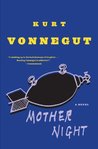
Mother NightMother Night by Kurt Vonnegut
My rating: 2 of 5 stars

Although Kurt Vonnegut's "Mother Night" shares some common themes - unspeakable horrors of World War II - with his "Slaughterhouse-Five", it does not rise to the greatness of that novel. In fact, while to me "Slaughterhouse-Five" is an unquestionable masterpiece of world literature, "Mother Night" is not even a good book. The novel contains plenty of examples of the author's trademark hilarious black humor and heavy sarcasm about the utter stupidity of the human race, yet it feels muddled, a little incoherent, and aiming at too many targets.

Howard W. Campbell Jr., an American, becomes one of the top propagandists of Nazi Germany. He works directly for Joseph Goebbels in the Propaganda Ministry, spewing racial hatred. He manages to escape to the U.S. after the war, where he spends many years in obscurity. Eventually he is brought to a trial in Israel for crimes against humanity, while he is treated as a saint by several groups of American morons who aim to "keep American bloodstream pure" and want to get rid of the Jews, blacks, Catholics, and Unitarians.

However, we soon learn that things are not as they seem, and many people, including Howard W. himself, are not at all what they pretend to be and not what they seem to be. Mr. Vonnegut conveys the motto of his novel at the beginning: "We are what we pretend to be, so we must be careful about what we pretend to be." In a show of arrogance I will disagree with Mr. Vonnegut. To me the motto (if one needs a motto in a literary work, which I doubt) would be hinted at by the following sentences: "All people are insane [...] They will do anything at any time, and God help anybody who looks for reasons." And "[...] this is a hard world to be ludicrous in, with so many human beings so reluctant to laugh, so incapable of thought, so eager to believe and snarl and hate."

A mediocre book by a great author.

Two stars.


View all my reviews

Tuesday, February 10, 2015

The Bones In The Attic (Charlie Peace, #7)The Bones In The Attic by Robert Barnard
My rating: 2 of 5 stars

After quite a serious read - Julio Cortazar's stories - I was in the mood for something very light and inconsequential, a literary trifle. Robert Barnard comes to the rescue in such moments. His "The Bones in the Attic" has delivered exactly what I needed - a fast and rather pleasant read that has not taxed my brain or affected my emotions.

Matt Harper, an ex-footballer (it is a British book so 'football' rightly refers to the sport where the ball is touched only by players' feet) and a local radio and TV celebrity buys a house in Leeds, where he finds the skeleton of a child in the attic. The police are notified, but being busy with more important, current cases, they just help Matt conduct his own investigation.

In a cosmically improbable coincidence it turns out that Matt was in the exact same area in Leeds at the exact time that the bones date to. He begins reminiscing the summer of '69, when he was seven years old and played football with a group of a bit older kids. It soon becomes clear that they are somehow connected with the case.

I envy Matt the ability of remembering faces and conversations from 30 years ago. I wish I remembered what happened this morning. I liked reading the book, but I do not think it is a particularly good one.

Two and a quarter stars.


View all my reviews

Sunday, February 8, 2015

Blow-Up and Other StoriesBlow-Up and Other Stories by Julio Cortázar
My rating: 4 of 5 stars

Another overlong review, which again highlights my lack of writing skills. I apologize.

A simple-minded definition of surrealism in art would emphasize the blending of reality with alternative realities, or with obvious non-realities, in such ways that the boundaries disappear between what is real and what cannot be real. Under such simplistic definition, most stories from Julio Cortazar's "Blow-Up and Other Stories" are surrealistic. In "Letter to a Young Lady in Paris", amidst the grim reality of explaining his intentions to commit suicide, the narrator keeps vomiting little rabbits. In the famous "Bestiary" a girl spends her summer in a house, where a dangerous tiger wanders freely between various rooms, and the family members need to be very careful to avoid the locations where the tiger resides at the moment. In other stories the narrator may meet himself from his youth or become the part of the story that is being told. I like the surrealistic aspect of Mr. Cortazar's collection. A disclaimer: my favorite painter is Rene Magritte, clearly a surrealist.

What I like more is exemplified by the very beginning paragraph of the title story, "Blow-Up": "It'll never be known how this has to be told, in the first person or in the second, using the third person plural or continually inventing modes that will serve for nothing." For Mr. Cortazar the story is less important than how it is told. Also, he is fascinated by the relationship between the "I" and the "non-I", how reality changes when viewed from either point of view, and what the boundaries are between the reality and its perception.

The title story, in fact, might be categorized as hyperrealistic (here's a facile definition of hyperrealism: a situation when one cannot distinguish reality from its representation). An amateur photographer takes a picture of a puzzling scene between a man and a woman in a park, magnifies the picture in his lab, and then sort of merges with the photographically represented world.

OK, no more labels, no more sur- and hyper-. I am inclined to treat the aspects discussed above, as well as the non-linearity of the story telling, as literary gimmicks and games played with the reader. What instead I like the most about some of Mr. Cortazar's stories is the beauty and power of his writing. In my view, if I were to delete all references to the tiger in "Bestiary", the story would not lose any of its impact as a chronicle of one summer told from the point of view of a child. "End of the Game", where kids play the Statues and Attitudes game for the benefit of the passing train's passengers, is also magnificent, regardless of whether Ariel appears or not. These stories evoke childhood memories and bring back feelings I had over a half of century ago, when I was, say, 8 or 12 years old. The stories belong in such distinguished company of best writings about childhood as J. M. Coetzee's "Boyhood" or A. Nothomb's "Loving Sabotage".

"The Pursuer", the longest piece in the collection, virtually a novella, has disappointed me a little. The realistic story of Johnny Carter, the great sax player (obviously modeled on Charlie Parker) and Bruno, his biographer, reads well, except for dialogues, which do not sound natural to me. Maybe it is the translator's fault? I can't tell as sadly I do not know Spanish. This story would only get two stars from me as it is rather flat and predictable.

Three and three-quarter stars.


View all my reviews

Tuesday, February 3, 2015

Murder on the Thirty-first FloorMurder on the Thirty-first Floor by Per Wahlöö
My rating: 2 of 5 stars

Per Wahlöö is one half of the Swedish mystery writing duo Sjöwall and Wahlöö, who - between 1965 and 1975 - wrote a great series of crime novels featuring inspector Martin Beck and detectives Lennart Kollberg, Gunvald Larsson, Einar Ronn, etc. The series contains some of the best police procedurals I have read in my life; I find "The Laughing Policeman" and "Roseanna" the most outstanding. In addition to highly realistic and captivating plots, the books present quite a critical view of the Swedish "welfare state" society.

Per Wahlöö's "Murder on the Thirty-First Floor" is not a part of the Martin Beck series. It is quite a unique crime novel: a dystopian police procedural. The action takes place in an unnamed country (Sweden could very well be the location) at some point in not a very distant future. The government is involved in a massive social engineering experiment: heavy censorship and restrictive social policies are used in the name of creating "social equality". The newspapers and magazines can print only positive news and stories, which make the readers feel good. The anti-alcohol policies are draconian; for example, the police can arrest people for getting drunk in their own homes.

The country has only one magazine publishing concern, a conglomerate that produces all 144 magazines available in the country. Chief Inspector Jensen is ordered by the Chief of Police to an emergency - the directors of the concern have received a letter with a bomb threat against their main building, which is the workplace for thousands of people. After supervising the evacuation, the Chief Inspector is given seven days to find the author of the threatening letter. The plot is quite straightforward, and I have not found it very interesting.

The most interesting parts are the Orwellian fragments like, for instance, "'True' reporting is not always the best! 'The truth' is a commodity which must be handled with utmost caution in modern journalism. You cannot be sure that everyone will tolerate it as well as you can." The higher a person is in the organizational hierarchy, the stupider he or she is. The publisher, who is at the very top of the concern, is a complete, utter idiot, the managing directors are all idiots, the lower-level directors are morons, etc. In addition, the secret of the thirty-first floor is plausible and compelling.

One thing I do not understand. Mr. Wahlöö as well as Ms. Sjöwall used to call themselves Marxists. Marxism (which I believe I know a bit as I grew up in its shadow) resulted in one of the most catastrophic social engineering experiments in human history. Yet the author criticizes a similar kind of social engineering to the one that Marxism led to. I do not get it.

Two and a half stars.


View all my reviews

Monday, February 2, 2015

The Chain of ChanceThe Chain of Chance by Stanisław Lem
My rating: 4 of 5 stars

The world mainly knows Stanislaw Lem as a science fiction writer. Wikipedia says that toward the end of the 20th century he was the most widely read science fiction writer in the world and that his books were translated from Polish into over 40 languages and sold over 45 million copies. His famous novel "Solaris" was adapted for movies three times. However, saying that Mr. Lem was a science fiction writer is akin to calling Thomas Jefferson an architect. Yes, Mr. Jefferson was quite an accomplished architect, but he also did some other, more important things. Similarly, Mr. Lem wrote some science fiction, and yes, it was some of the best (in fact, I think the best) ever written, but he really was a philosopher of science, a futurologist strongly grounded in science and technology, and one of the world's deepest intellectuals. Some of my most beloved works by Mr. Lem are the collections of essays, Philosophy of Chance and Summa Technologiae, which have a lot to do with science (and mathematics), but definitely not with fiction.

I do not like science fiction because I am not interested in imagined worlds (I do not like fantasy for the same reason). Our own world is so fantastically complex, interesting, and hard to penetrate that I do not see the need of creating alternative worlds (my own version of "Occam's razor").

When I was growing up in Poland, I read all Lem's books in my native language. "The Chain of Chance" (Polish title is "Katar", meaning "Catarrh") is the first one that I have read in English (simply because someone borrowed the original and never cared to return it). This book has nothing in common with science fiction. It is one of the two or three mysteries written by Mr. Lem.

An aging American astronaut is investigating a cluster of unexplained deaths (usually suicides that follow periods of depression and severe hallucinations) of late-middle-age men in and around Naples, Italy. The novel might be called a scientific and philosophical mystery as it deals with detailed analysis of various factors, which are common for all unexplained cases, with statistics and probability theory.

The novel has some great writing (the translation by Louis Iribarne is flawless); until about page 60 the reader does not know at all what is going on, yet the events and the prose are captivating. The description of hallucinations is perhaps the best I have ever read. The denouement, although maybe a bit disappointing, is logical and strongly anchored in science. If you like a mystery that is totally different than the mainstream mysteries, "The Chain of Chance" is something for you.

Four stars.


View all my reviews