Sunday, November 9, 2014

Side EffectsSide Effects by Woody Allen
My rating: 5 of 5 stars

Woody Allen’s “Side Effects” is most likely the funniest book I have read in my life. Almost each of the about two hundred pages contains at least one passage that made me laugh out loud, which makes things a bit tricky, especially when you read on the trolley and your fellow passengers look at you suspiciously and move to far-away seats.

Already the second paragraph on the first page is hilarious: “Needleman was constantly obsessing over his funeral plans and once told me, ‘I much prefer cremation to burial in the earth, and both to a weekend with Mrs. Needleman’”. As a mathematician I cannot avoid to laugh out loud at the “Oh, I ran into Isosceles. He has a great idea for a new triangle.” And the totally fabulous passage “More than any other time in history, mankind faces a crossroads. One path leads to despair and utter hopelessness. The other, to total extinction. Let us pray we have the wisdom to choose correctly.” And yet one more pearl of humor: “Never before has pornography been this rampant. And those films are lit so badly!”

Most of the book is just pure fun and devoid of any deeper content. However, I found four stories to be much more meaningful. “The Kugelman Episode” in which professor Kugelman meets Emma Bovary thanks to magician Persky (funny, I once met a Mr. Persky in Zakopane, and he was sort of a magician). Then “The Shallowest Man”, which is a great story about death and love. In “Fabrizio’s: Criticism and Response” Mr. Allen displays virtuoso literary skills writing about pasta. Finally, “Retribution” is one of the funniest stories about sex I have ever read.

What the heck, I am going to round my four and a half star rating up. The book is, of course, nothing in the class of Coetzee, Pynchon, Joyce, Faulkner, Vonnegut, etc., but the sheer hilarity factor is stunning. Allow me one last quote: “Wittgenstein used the above model to prove the existence of God, and later Bertrand Russell used it to prove that not only does God exist but He found Wittgenstein too short.” The previous five-star book I have read, Vonnegut's "Slaughterhouse Five", is a masterpiece. This one is not, but it has been so much fun to read it.

Four and a half stars.


View all my reviews

Friday, October 31, 2014

Lost in Translation: A Life in a New LanguageLost in Translation: A Life in a New Language by Eva Hoffman
My rating: 5 of 5 stars

Eva (originally Ewa) Hoffman's autobiographical book "Lost in Translation: A Life in a New Language" is the fourth great book about childhood and growing up that I have read recently. It belongs in such a distinguished company as James Joyce's "Portrait of the Artist as a Young Man", John Coetzee's "Boyhood", and Amelie Nothomb's "Loving Sabotage". It is perhaps not as deeply intellectual as Joyce's work, not as fiercely social and political as the Coetzee's book, and not as utterly charming as the Nothomb's novel, but it is a great, wise, and deep book. Of course I may be biased - the book is mainly about the contrast between Polishness (which is my ethnicity) and Americanness. I am also both a Pole and an American (meaning USian) and I can relate to most things Ms. Hoffman writes about.

The author was born in a Jewish Polish family. When the political climate became milder in Poland in the late Fifties, the family was allowed to emigrate to Canada. Ms. Hoffman was 13 at that time, which is probably the most difficult age to emigrate. The family boards the ocean liner "Batory" and they finally arrive in Vancouver, after a trans-Canada train ride.

The book is built of three parts: the first, "Paradise", is mostly about the author's childhood in Cracow, Poland. I find that part most moving as I am about the same age and I remember a bit of the late 1950s. The second part, "Exile", is about Ms. Hoffman's youth in Canada and in the US, and in the third part, "The New World", she is a young adult or a grown-up. She studies at Rice University and at Harvard, and becomes a literary critic and a writer.

There are so many wonderful passages in the book that it would take me many, many pages to quote them. Let me just quote two fragments that so aptly characterize the essence of Polishness: "Politics, like religion, is a game, except almost no one - no one we know anyway - seems to believe in it. Poles don't need demystifying philosophies to doubt all sources of power and authority". And "A culture talks most about what most bothers it: the Poles talk compulsively about the Russians and the most minute shifts of political strategy. Americans worry about who they are." How very true this is!

I find the passages about becoming immersed in a new language the most fascinating - what becoming bilingual does to one's brain and to the worldview. It is like appreciating the world and life twice as much.

Wonderful book!

Four and three quarter stars.


View all my reviews

Tuesday, October 14, 2014

Slaughterhouse-FiveSlaughterhouse-Five by Kurt Vonnegut
My rating: 5 of 5 stars

So it goes.

So goes one of the most horrifying novels I have read in my life. I have just reread "Slaughterhouse Five" by Kurt Vonnegut, which I first read about 40 years ago, in translation.

Billy Pilgrim is unstuck in time and relives various fragments of his life, in the US, in Europe during World War II (when he meets Kurt Vonnegut, the author), in particular during the destruction of Dresden, and as a zoo exhibit on planet Tralfamadore.

It took me over a week to read this short book; I just could not stomach the truth about the wretched human species. I am embarrassed by being a member of a species that burns their members in ovens (bad guys, the Germans, did that by millions in concentration camps) or boils schoolgirls alive (good guys, the Americans, did that by thousands in Dresden). I am embarrassed by how wars are in the very human nature, how mass murders cannot be avoided. How the wars are fought by children, when most adult soldiers are dead. How absurdly random human lives are.

I do not like the Tralfamadoria bit and do not much care for the Kilgore Trout story, yet
this is a great book, a must read, a masterpiece. The blurbs on the cover scream "Poignant and hilarious". Yes, absolutely. Hilarious and very, very, very sad. "Nobody held it against him that he dropped jellied gasoline on people. But they found his halitosis unforgivable. But then he cleared that up, and he was welcome to the human race." And poor Edgar Derby, who has survived the unimaginable horrors of war, is executed for stealing a teacup. I really think that whoever is proud to be a human might be an idiot. Birds are smarter; they can say "Poo-tee-weet".

Five stars.


View all my reviews

Sunday, October 5, 2014

I Can See in the DarkI Can See in the Dark by Karin Fossum
My rating: 3 of 5 stars

Norway's Karin Fossum is one of my favorite mystery authors. Her "Black Seconds" and "Indian Bride" are solidly five-star works, some of the best mysteries I have ever read in my life. "I Can See in the Dark" is not Ms. Fossum's best novel, although it is very readable. I do not like the term "page turner" as it implies inferior quality of writing - one just wants to turn the pages to follow the plot rather than savor the writing, but while "I Can See in the Dark" is a page turner, it is - as always with Ms. Fossum's work - beautifully written. The author uses short simple sentences, ably translated from Norwegian by James Anderson.

Riktor works as a nurse caring for elderly people at the Lokka nursing home. He is not a typical nurse, though, and he has dark secrets. He is accused of murder, but there is something deeply perverse about the whole set-up. The plot is really engrossing, but very, very dark. There is a passage, mid-novel, about Riktor's behavior with his patients that made my skin crawl.

Ms. Fossum is younger than me, but still, at 60 she is quite mature. This is a book for old people, for people who understand the vagaries and randomness of life. This is also a painful book about dying. "I often think about the old people in their beds at Lokka. Those cavernous faces, those bony hands always groping for something to hold on to. They, who have seen and understood about life and how it should be lived. I know so much more now, they think; I understand things at last, but it's too late. Now the greenhorns are coming to take over, and they won't listen to us, lying here twittering like birds." Yes, now I understand things, but it is way too late.

A very good mystery, but one that does not transcend the genre.

Three and a half stars.


View all my reviews

Wednesday, October 1, 2014

The Demon in the Freezer : A True StoryThe Demon in the Freezer : A True Story by Richard Preston
My rating: 2 of 5 stars

With the first case of Ebola occurring in the U.S., I guess I chose the right time to read Richard Preston’s “The Demon in the Freezer” (2002). It is a non-fiction book that deals with the potential dangers of biological warfare. The main focus is on smallpox virus and anthrax bacterium, although the Ebola virus is frequently mentioned too.

The story begins in September 2001, one week after 9/11, when a letter to Senator Daschle's office in Washington D.C. is found to contain anthrax, and five people die as a result. The story then tracks back to 1970, when an outbreak of smallpox occurred in the small town of Meschede, Germany. A large portion of the book is about the Eradication (capital letter intended) effort, which united medical personnel of many countries on a quest to achieve global elimination of variola, the smallpox virus, which - according to the author - is generally believed to be the most dangerous virus to the human species. Variola was officially eradicated in 1979, although large supplies of the virus remain stored in the health agencies' vaults in U.S. and Russia (and, quite likely, in other countries too).

Several passages about the fight against smallpox are fascinating, for example the fragment that describes how a smoke-producing machine helped discover the mechanisms of the virus' travel through the hospital. I have also found the pages about insect viruses engrossing.

Richard Preston is known for his sensationalism, and this book is no exception. While the story about the smallpox eradication effort is deeply moving, most other sub-stories are written in a somewhat hysterical tone. Also, the author's attempts to "humanize" the protagonists are lame; why do we need to know that this or that doctor was a short and stout woman with brown eyes? Or that they drank whiskey or smoked cigars? What probably bothers me most, though, is that the book lacks focus; instead of telling one compelling story it is all over the place, jumping here and there.

The penultimate chapter is about virus engineering, which raises the prospect of horrible biological wars. I am way too old to worry about myself, but I am worrying about my child and my grandchildren.

An interesting and well-meaning book, if rather poorly written.

Two and a half stars.


View all my reviews

Friday, September 26, 2014

The Collini CaseThe Collini Case by Ferdinand von Schirach
My rating: 3 of 5 stars

Baldur von Schirach was one of the top officials in Nazi Germany; he was the leader of the Hitler-Jugend (Hitler Youth) organization. Convicted for crimes against humanity in 1946, he spent 20 years in Spandau prison in Berlin. Ferdinand von Schirach, a lawyer and a writer, whose books have been translated into more than 35 languages, is his grandson. "The Collini Case" (2011) is a good courtroom drama. I find it better than many of John Grisham's novels.

Fabrizio Collini, an elderly man, a toolmaker posing as a Corriere della Serra reporter, visits an 85-year old rich industrialist, Herr Meyer, in a hotel in Berlin. He kills him, and defaces the body ("He couldn't stop, he kept grinding his heel into that face while blood and brain matter spurted over his trouser leg, the carpet, the bedstead.") Then he calls the police, sits down in the lobby, and waits for the law to come. Caspar Leinen, a young attorney on standby duty for legal aid (something like the public defender office in U.S.) picks up the case, against a famous and very experienced prosecution attorney.

I find the plot interesting and "The Collini Case" is a hard book to put down. The denouement is plausible and consistent with the setup. The author, being a criminal law practitioner, obviously knows about the court process in his country. I also like the writing; the sentences are mostly short and simple, yet they well convey the visuals (the translator must have contributed to the overall quality). The best thing of all is that the novel is only 186 pages long. No fluff, no padding, no extraneous stuff that many American writers so love to use to increase the volume. Way to go!

Three and a half stars.


View all my reviews

Monday, September 22, 2014

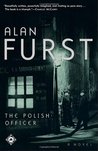
The Polish Officer (Night Soldiers, #3)The Polish Officer by Alan Furst
My rating: 2 of 5 stars

Although Alan Furst's "The Polish Officer" (1995) came highly recommended by a friend of mine whose judgment I value and trust, I feel a little disappointed having read the book. It is a rather standard spy novel slash war story fare; Daniel Silva's books, which I do not like at all, are quite similar, with the exception that Mr. Furst is obviously a better writer. The novel is written with great sympathy for Polish people and Polish resistance fighters in particular, but I am not allowed to be biased because of my country of birth.

September 1939 in Warsaw: Germans attack Poland from the west, thus beginning the Second World War. Soon the Soviets attack from the east. Captain Alexander de Milja joins the Polish underground resistance army and his first task is to transport Polish National Bullion Reserve gold to Romania and then to Paris. The plot follows de Milja's exploits in various European countries as he excels in spying, diversion, and sabotage craft fighting the Germans and Russians. Toward the end the book is less of a "historical spy novel" (the author's characterization of his work) and more about the horrors of war.

The novel has several lighter, funny passages, for instance, when Sturmbannfuhrer Grahnweis leaves the hotel by the Saint-Rustique side of the building: "For a time it wasn't clear that Grahnweis was ever going to be found, but, with persistence and painstaking attention to detail, he was" (based on crown on the second bicuspid molar).

Captain de Milja is a success with women and the sex scenes are discreet and well written. A few gems like "She was that indeterminate age where French women pause for many years - between virginal girlhood (about thirty-five) and wicked-old-ladyhood..." demonstrate the author's sharpness of observations. Yet, all in all, I find "The Polish Officer" a rather unremarkable novel.

Two and a half stars.


View all my reviews