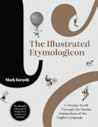
 The Illustrated Etymologicon by Mark Forsyth
My rating: 3 of 5 stars
An entertaining and illuminating read! Mark Forsyth presents the etymology of several hundreds of English words and phrases and often surprising connections between them. We begin with "book" and end with "book," which justifies the subtitle "A Circular Stroll Through the Hidden Connections of the English Language." So a book, via gambling, leads us to pool, from which we go to gene, then to testicle, and from there to codpiece..., etc. It may seem random, but the author convincingly justifies the chain.
Below are some snippets or quotes taken from the chain of connections that I found most interesting or amusing. As a mathematician teaching probability, I found "[...] if probable comes from the same root as prove, can you guess why the proof of the pudding is in the eating?" On a similar topic, the origins of the arithmetic signs, such as plus and equal sign are explained.
We learn the origins of the word "spam," and as a bonus, Monty Python is mentioned, which is always a good thing, particularly if it leads to bringing up Python, a programming language. The author clearly shows that the two most popular four-letter swearwords are not acronyms, despite the popular urban legend claiming so. Speaking about legend, how can we not admire the author's cool turn of the phrase, "According to legend (the beautiful elder sister of truth [...])"?
I found fascinating the history of language(s) spoken by people inhabiting the current teritory of Britain, whom the ancient Greeks called "Prittanoi," which meant "tattooed people." Also, I learned a new word: woad. The etymology of "Starbucks" and "serendipity" were further highlights for me.
One can find plenty of humor in Etymologicon, like, for instance, in the fragment detailing Ovid's story about Halcyon: "Of course, modern biologists scoff at Ovid's story and dismiss it purely on the base that it isn't true. However, poetry is much more important than truth, and, if you don't believe that, try using the two methods to get laid."
The book ends with a series of quizzes checking the readers' intuitions about etymology of various words and phrases. But let's not talk about the quizzes, as my scores were rather distressingly low...
I would otherwise rate Etymologicon with four stars, for its educational value and humor, but the flood of illustrations and, generally, the graphical form of the book are, to me, totally distracting and greatly reducing the fun of reading. There are also a few pages with gold letters on black background rendering the text virtually unreadable for me.
View all my reviews

No comments:
Post a Comment